| Back to Genre |
 |
|
 |
Rating: Great |
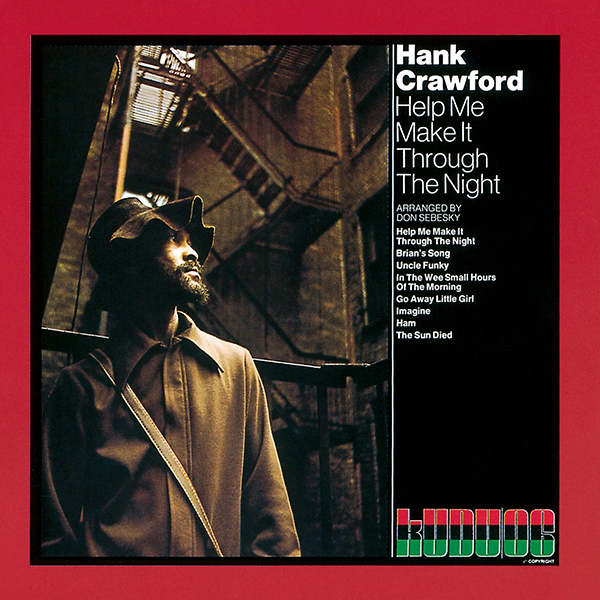
Hank Crawford was one of the first artists signed by Creed Taylor to the Kudu label. During his recording career (1971-1978), he faced heavy criticism, accused of making mellow and commercial albums. On the other hand, Hank reached a new level of popularity during his Kudu years. Some of the eight albums he recorded for the label sold over 100,000 copies without any promotion. His Kudu debut, Help Me Make It Through the Night, was the first step in this process of unprecedented fame. It is a true cult album for many saxophonists—including David Sanborn, Hank's most famous fan and disciple!
Bernie Ross Crawford, born on December 21, 1934, in Memphis, Tennessee, remains one of the most distinctive alto saxophonists in music history. He began studying piano at age nine and was soon playing in his church choir. As a teenager, he began playing alto sax in his high school band, influenced by Johnny Hodges, Charlie Parker, Louis Jordan, and Earl Bostic. At school, he associated with Phineas Newborn Jr., Booker Little, George Coleman, and Harold Mabern. Although their after-school hours were spent studying bebop, they professionally sank their teeth into the blues.
Before graduating from high school, Crawford played in bands led by Ben Branch, Tuff Green, and Ike Turner, and backed up B.B. King, Bobby Bland, and Junior Parker at various Memphis venues. In 1953, he attended Tennessee State College in Nashville, where he developed his arranging skills as the leader of the school's dance band.
His big break came in 1958, when Ray Charles visited Nashville. Baritone saxophonist Leroy Cooper had just left the band, and Charles offered Crawford the baritone chorus. In 1959, when Cooper returned, Crawford switched to alto saxophonist. Two years later, Charles expanded to a full big band and appointed Crawford musical director. By the time Crawford left Charles in 1963 to form his own seven-piece band, he had already established himself with several solo albums on Atlantic, for which he would release twelve albums in total.
Hank Crawford signed with CTI/Kudu in 1971 and appeared on Johnny Hammond's Breakout (recorded in June 1971), the first album released by CTI's new subsidiary. He soon received a call from Creed in August to work on his debut solo album for the label. However, he was unable to attend the second recording session, scheduled for September, and the famed producer offered Grover Washington, Jr. (who had been hired as one of the horn section members assembled for Crawford's album) the opportunity to emcee. The result was the Inner City Blues album, which launched Grover's enormously successful solo career.
Crawford's first official live performance as a CTI/Kudu artist was on July 18, 1971, on the memorable California Concert album, recorded live at the Hollywood Palladium. Although he played on several tracks, his most significant solo performance, a beautiful rendition of "Never Can Say Goodbye" (one of the songs he'd recorded for Johnny Hammond's Breakout), was not included in the original two-LP set and remains unreleased to this day.
A month later, Hank Crawford finally went to Van Gelder's Studio in New Jersey to begin recording the Help Me Make It Through the Night album. However, from their first session in August, Creed Taylor decided to use only one track, a song composed and arranged by Alfred Pee Wee Ellis with a strong brass section in the background. As mentioned, Hank didn't show up for the September session. Then, in January 1972, Creed decided to finish the album in a completely different musical direction, inviting other musicians (Cornell Dupree and Bernard Purdie were called in to replace Eric Gale and Idris Muhammad) and inviting Don Sebesky to write the string arrangements.
Aside from Pee Wee Ellis' "Ham" and Crawford's own "Uncle Funky" (later retitled "Bowl Full O' Blues" at the CTI Summer Jazz At The Hollywood Bowl concert, recorded on July 30, 1972, but not released until 1977), all the other songs are pop favorites. The title track, from country singer and future Hollywood star Kris Kristofferson's 1970 self-titled debut album, had already been a Top 10 pop hit thanks to a recording by singer Sammi Smith. Crawford transforms this erotic ballad into a bouncy funky-soul piece, featuring inspired performances from Cornell Dupree on guitar and the late Richard Tee, who plays the organ in his unmistakable style.
The ballad section includes John Lennon's peaceful anthem Imagine, Michel Legrand's film theme Brian's Song (subtitled The Hands of Time after the husband and wife team of Alan & Marilyn Bergman added the lyrics), and the title track from Frank Sinatra's first 12-inch LP for Capitol, In the Wee Small Hours of the Morning, arranged by Nelson Riddle in 1954 and recently rediscovered by pop (Carly Simon) and jazz (Keith Jarrett) heavyweights.
Plus: soulful renditions of hits by Carole King (Go Away Little Girl, a gem from her creative heyday in collaboration with Gerry Goffin, Carole's then-husband) and Ray Charles (The Sun Died, aka Il Est Mort Le Soleil, a favorite with jazz singers since it was covered by Betty Carter in 1969 and re-recorded by Shirley Horn in 1993 on her tribute to Charles, Light Out of Darkness).
There are many details to savor throughout the album: drummer Bernard Pretty Purdie's punchy groove on "Go Away Little Girl," vibraphonist Phil Kraus's subtle commentary on "In the Wee Small Hours," Cornell Dupree's bluesy guitar solo on "Uncle Funky," Margaret Ross's delicate harp embellishments on "Brian's Song." But above all, Crawford's moving sound, fused with Sebesky's sensitive arrangements. Romantic soul music at its finest, demonstrating why David Sanborn, who idolizes Crawford as his primary influence, loves "Help Me Make It Through the Night!" so much.
= Full Album Play List =
= Track List =