| Back to Genre |
 |
|
 |
Rating: Great |
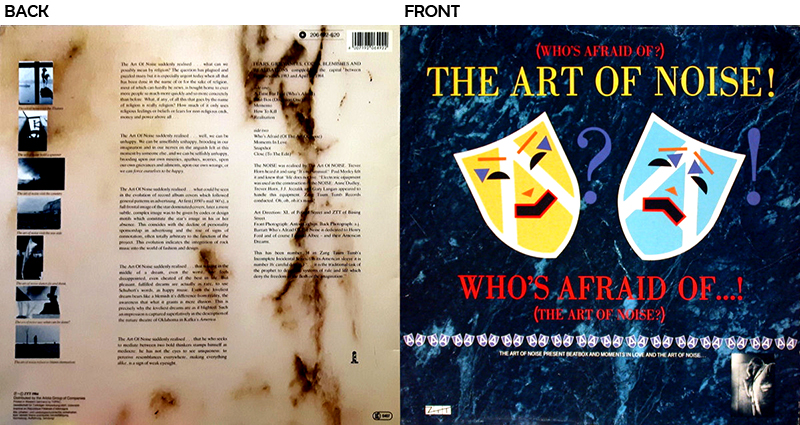
The 1980s were rife with contradictions. While arenas filled with classic stadium rock and radio charts were dominated by streamlined synthpop, something seemingly out of place lingered on the fringes. There, The Art of Noise existed, a collective that wrote its own rules, sampled its own voices, and crafted its own genre. Their 1984 debut album, “(Who's Afraid of?) The Art of Noise!”, wasn't a record you played to sing along to or identify a hit. It was a manifesto, a sonic project constantly asking itself: what is music, and who says it has to sound like this?
At first listen, the album sounded like a jumble. Punches, hammer blows, sampled sighs, electronic drumbeats that repeated until they almost broke free of the beat. But beneath that collage lay a precise structure. The collective worked with the Fairlight CMI, a revolutionary sampling instrument that not only captured sound but could also transform it into compositions. Where traditional bands arranged chords and melodies, Art of Noise arranged fragments, gestures, and textures. The compositions weren't played, but constructed.
And yet it wasn't a dry exercise in technical possibilities. The album was playful, playful, ironic. It felt as if it was looking at you with raised eyebrows. The titles, the transitions, the repetitions: everything seemed deliberately a bit too much, too long, too obvious. But those who listened long enough discovered its subtlety precisely therein. Instead of catering to the listener, the album challenged you. It wasn't a sound that could be used in the background. It demanded attention. And those who gave it were rewarded with something none of its contemporaries even approached.
Amidst all this lies an unexpected moment of pure beauty: “Moments in Love.” For ten minutes, the group drapes one of the most iconic melodies of the eighties over minimal rhythm, soft percussion, and a breathy silence. It's a love song without words, a slow jam without verse or chorus, an ambient miniature that unfolds with the slowness of trust. The song became a paradoxical success: too slow for the radio, too abstract for the dance floor, yet beloved at weddings, in hip-hop samples, and in the chill-out rooms of clubs worldwide. Here, Art of Noise demonstrated that even within a conceptual project, there could be room for genuine emotion. Not through vocals or lyrics, but through sound, timing, and atmosphere. “Moments in Love” is not only the heart of this album but also one of the rare occasions on which avant-garde and emotion fully understand each other.
What gave the album added power was that it was not only sonically experimental, but also visually. The videos that appeared on MTV were as strange, as elusive, as the music itself. They didn't focus on faces, but on images. Abstract montages, glitchy edits, rhythmically connected to the sample structures of the sound. The band itself remained deliberately vague—no clear frontman, no recognizable look. This made Art of Noise simultaneously mysterious and modern. They fit perfectly into an era in which visual culture was rapidly evolving, yet they chose not to adapt. They presented themselves as a brand rather than a band, as a concept rather than a group of musicians.
At a time when MTV was turning artists into pop icons based on charisma and appearance, Art of Noise opted for invisibility. The music had to speak, or rather: bump, squeak, and slide. Yet it found its way to a wide audience. Not through traditional channels, but through dance floors, student radio stations, and arts radio stations. And for those who were open to it, this music fundamentally changed something. It showed that pop didn't necessarily need vocals and choruses. That rhythm could also consist of fragments. And that repetition wasn't a limitation, but rather an entryway to meaning.
What's most striking about this debut, in retrospect, is how fresh it remains. Much of the music from that era now sounds dated, trapped by production choices or temporary trends. But Art of Noise had no frame of reference from the start. They made music without time, without genre, without an audience in mind. And that's what makes the record so enduring. It's not a nostalgic artifact, but rather a blueprint. Much of what later emerged under electronic music, ambient pop, or even sample-based hip-hop has something of Art of Noise in it. Not as a direct influence, perhaps, but as a spirit. As a space where freedom is paramount.
For anyone who listened to this album in 1984, it must have been both confusing and liberating. Nothing sounded like it before, and little has since. It was music that didn't try to please, but to surprise. And within that surprise lay a certain poetry. A kind of logic that only revealed itself once you gave up your resistance. It's therefore no wonder the album is still admired today. Not as a pop classic, but as a groundbreaking step in what pop music can be.
= Full Album Play List =
= Track List =